

Moving to France is a bold dream, yet the reality of local paperwork can feel overwhelming. You want to launch your own business but fear losing the comfort of a social safety net. It is a common stress that keeps many talented professionals from taking the leap into independence.
We believe you should focus on your craft rather than legal hurdles. This is where a unique French model comes into play to offer you total peace of mind. By using portage salarial English experts can provide, you get the best of both worlds.
This system allows you to enjoy freelance freedom while keeping the benefits of a full-time contract. Our guide provides a clear portage salarial explained english speakers can easily follow. Let us help you navigate this path with confidence and security.
Table of Contents
Key Takeaways
- Combines freelance flexibility with traditional employee legal protections.
- Ensures access to the comprehensive French social security system.
- Eliminates the need for complex business registration and accounting.
- Provides a stable monthly salary based on your client billings.
- Offers a secure framework for international experts working in France.
- Simplifies administrative tasks through a dedicated umbrella company.
1. What is Portage Salarial? Understanding the French Employment Model
The concept of Portage Salarial represents a significant shift in how professionals work in France, combining flexibility with employment benefits. This section aims to demystify the Portage Salarial model by exploring its definition, the three-party relationship it involves, and its legal recognition in France.
1.1 Definition and Core Concept of Portage Salarial
Portage Salarial is a French employment model that allows professionals to work independently while benefiting from the security of being employed. At its core, it involves a tripartite relationship between the professional, a portage company (or umbrella company), and the client.
The core concept revolves around the portage company acting as an intermediary, providing administrative support and employment benefits to the professional, who works on projects for clients.
1.2 The Three-Party Relationship Explained
This relationship is fundamental to understanding how Portage Salarial works. It involves:
1.2.1 The Salaried Professional (You)
As a salaried professional under Portage Salarial, you maintain your independence in choosing projects and clients while being employed by the portage company. This status provides you with social security benefits and unemployment insurance.
1.2.2 The Portage Company (Umbrella Company)
The portage company serves as your employer, handling administrative tasks, invoicing clients, and managing your employment benefits. They play a crucial role in simplifying your work life.
1.2.3 The End Client
The end client is the entity that contracts your services through the portage company. You work on projects for this client, and your work is facilitated by the contractual agreement between the client and the portage company.
1.3 Origins and Legal Recognition in France
Portage Salarial has its roots in France, dating back to the 1990s. It gained legal recognition and was formalized into the French labor code, providing a legal framework that protects the rights of all parties involved.
- Legalized to provide flexibility and security to professionals.
- Governed by specific laws that dictate the responsibilities of each party.
- Recognized as a valid employment model, offering benefits to both professionals and businesses.
2. Portage Salarial Explained English: How the System Actually Works
For English-speaking professionals in France, grasping how Portage Salarial works can be the key to leveraging its full benefits. This employment model is designed to offer the flexibility of freelancing while maintaining the security of an employment contract.
2.1 The Contractual Framework
The contractual framework of Portage Salarial is built around two primary agreements: the employment contract with the portage company and the service agreement with the client.
2.1.1 Employment Contract with the Portage Company
When you join a portage company, you enter into an employment contract. This contract establishes your status as an employee of the portage company, entitling you to the benefits and protections afforded by French labor law.
2.1.2 Service Agreement with Your Client
Simultaneously, you will negotiate a service agreement with your client. This agreement outlines the scope of work, payment terms, and other conditions specific to the project. The portage company will typically be a party to this agreement, ensuring that it aligns with the employment contract.
2.2 Payment Flow and Invoice Management
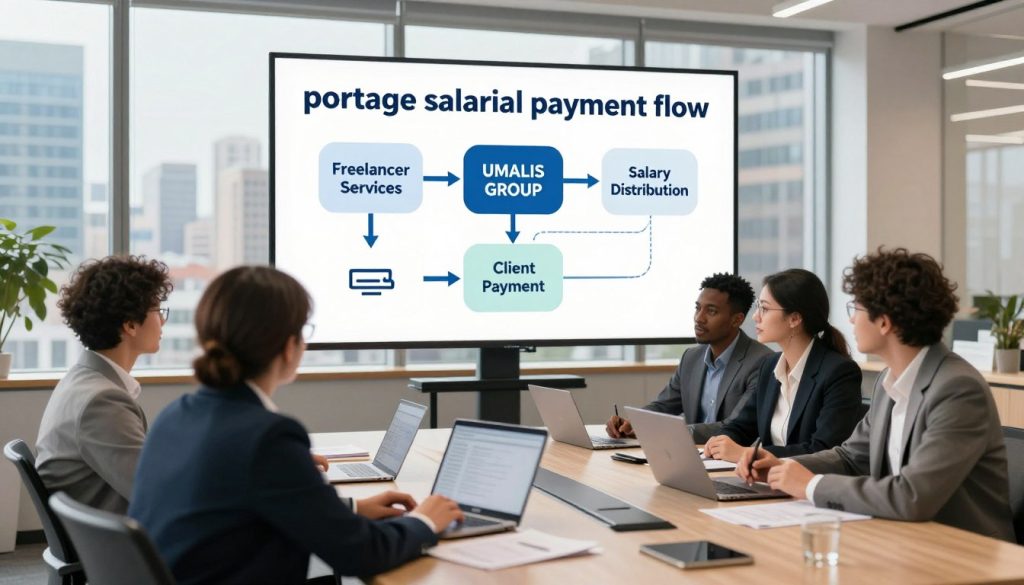
The payment process in Portage Salarial involves several steps. You, as the contractor, will invoice your client through the portage company. Once the client settles this invoice, the portage company calculates the applicable taxes and social contributions, then pays your salary. This process is illustrated in the following diagram:
This system ensures that your income is processed professionally, with all necessary deductions made at source.
2.3 Monthly Salary Calculation Process
Your monthly salary is calculated based on the invoices you’ve submitted and paid by clients. The portage company will deduct management fees, social contributions, and taxes before crediting your account. Understanding this process helps you manage your finances effectively and anticipate your net income.
By breaking down the operational aspects of Portage Salarial into these key components, professionals can better navigate the system and make informed decisions about their career paths.
3. Who Can Benefit from Portage Salarial in France?
Understanding who can benefit from Portage Salarial is crucial for professionals considering this employment route in France. Portage Salarial is not suitable for everyone, but it offers a unique blend of independence and employment security that can be highly beneficial for certain professionals.
Legal Eligibility Requirements
To be eligible for Portage Salarial, professionals must meet specific legal requirements. These include being registered with the relevant French authorities and having a certain level of professional experience or qualifications.
- Registration: The professional must be registered with the Registre du Commerce et des Sociétés or the Répertoire des Métiers.
- Professional Experience: Typically, having a certain level of professional experience is necessary, though this can vary depending on the portage company and the nature of the work.
Ideal Professional Profiles and Experience Levels
Portage Salarial is particularly suited to professionals who value independence but also want the security of being employed. This includes:
- High-Earning Professionals: Those who can command high daily or hourly rates, often in consulting or specialized services.
- Experienced Freelancers: Individuals with significant experience in their field who are looking for a more stable arrangement without losing their independence.
- Professionals Working with Large Corporate Clients: Those who work with big companies and need the protection and benefits that come with being employed.
Industries and Sectors Where Portage Thrives
Certain industries are more conducive to Portage Salarial due to the nature of the work, the demand for specialized skills, and the prevalence of freelance or contract work. These include:
- IT and Technology: Software development, cybersecurity, and data analysis are sectors where Portage Salarial is common.
- Consulting: Management, strategy, and HR consulting are popular areas for Portage Salarial.
- Creative Industries: Professionals in design, marketing, and media often use Portage Salarial to manage their careers.
| Professional Profile | Eligibility Criteria | Benefits |
|---|---|---|
| High-Earning Professionals | Registration with relevant French authorities, significant professional experience | Employment security, access to social security benefits |
| Experienced Freelancers | Professional experience, ability to command high rates | Independence with employment benefits, simplified administrative tasks |
| Foreign Professionals | Registration, professional qualifications recognized in France | Access to French social security, simplified administrative processes |
Specific Advantages for Foreign Professionals
For foreign professionals, Portage Salarial offers several advantages, including:
- Simplified Administrative Processes: Managing administrative tasks can be challenging for foreign professionals; Portage Salarial simplifies this by handling tasks such as invoicing and tax compliance.
- Access to French Social Security: Being part of the French social security system provides access to healthcare, unemployment benefits, and retirement pensions, which can be particularly beneficial for those new to France.
“Portage Salarial has been a game-changer for me. It allows me to work independently while having the security of being employed.”
4. Key Benefits of Employee Portage France

Portage Salarial offers numerous benefits for professionals in France, enhancing their career stability and security. This employment model combines the advantages of being an employee with the flexibility of independent work, making it an attractive option for many.
4.1 Full Social Security and Healthcare Coverage
One of the primary benefits of Portage Salarial is the access to full social security and healthcare coverage. As a porté, you are entitled to the same social benefits as traditional employees, including health insurance, maternity leave, and other social protections.
4.2 Unemployment Insurance and Retirement Contributions
Through Portage Salarial, professionals gain access to unemployment insurance and retirement contributions. This means that if you were to lose a mission or decide to stop working, you could be eligible for unemployment benefits. Moreover, your retirement contributions are taken care of, ensuring a more secure financial future.
4.3 Professional Independence with Employee Status
Portage Salarial allows professionals to maintain their independence while enjoying the benefits of employee status. This unique blend enables you to choose your projects, manage your workload, and still benefit from the protections and benefits associated with being an employee.
4.4 Administrative Support and Simplified Management
Another significant advantage is the administrative support provided by the portage company. They handle tasks such as invoicing, tax declarations, and social contributions, simplifying your administrative burden and allowing you to focus on your core work.
4.5 Access to Professional Development and Training
Finally, Portage Salarial often provides access to professional development and training opportunities. This can help you enhance your skills, stay updated with industry trends, and advance in your career.
The benefits of Portage Salarial can be summarized in the following table:
| Benefits | Description |
|---|---|
| Full Social Security and Healthcare Coverage | Access to health insurance, maternity leave, and other social protections |
| Unemployment Insurance and Retirement Contributions | Eligibility for unemployment benefits and secure retirement contributions |
| Professional Independence with Employee Status | Flexibility to choose projects and enjoy employee benefits |
| Administrative Support and Simplified Management | Handling of invoicing, tax declarations, and social contributions by the portage company |
| Access to Professional Development and Training | Opportunities to enhance skills and advance in your career |
5. Understanding Costs and Fees in Portage Salarial
The financial landscape of Portage Salarial includes several key components that professionals must understand to manage their finances effectively.
Management Fees: What Portage Companies Charge
The umbrella company collects a fee for covering administrative tasks, and in return, contractors receive a monthly payslip and benefits. The fee typically ranges between 7-10% of the invoice amount.
This fee covers a variety of services, including administrative support, legal compliance, and access to benefits that might otherwise be unavailable to independent contractors.
Social Contributions and Tax Deductions
Social contributions and tax deductions are significant aspects of Portage Salarial. These include contributions to social security, healthcare, unemployment insurance, and retirement funds.
Understanding these deductions is crucial for anticipating your net income. The table below provides a breakdown of typical deductions:
| Deduction Type | Approximate Percentage | Description |
|---|---|---|
| Social Security | 10% | Contributions to the French social security system |
| Healthcare | 2% | Healthcare coverage contributions |
| Unemployment Insurance | 4% | Insurance against unemployment |
| Retirement Contributions | 8% | Contributions towards retirement funds |
Professional Expense Reimbursements
Professionals under Portage Salarial can have certain expenses reimbursed, which can impact their net income. Common reimbursable expenses include travel costs, professional training, and equipment purchases.
Real Net Income Calculation with Examples
Understanding how to calculate the real net income is crucial. It involves considering the management fees, social contributions, and any reimbursements.
For example, if your invoice amount is €10,000, with a management fee of 8%, your net income before other deductions would be €9,200. After social contributions and taxes, your take-home pay could be significantly lower.
6. Legal Framework and Your Rights as a Porté
Navigating the legal landscape of Portage Salarial is crucial for understanding your rights and obligations as a porté. The French legal system provides a comprehensive framework that governs this employment arrangement, ensuring security and clarity for both the porté and the portage company.
French Labor Code Provisions for Portage Salarial
Portage Salarial is fully recognized and regulated by the French Labor Code (Code du Travail). This legal recognition provides a solid foundation for the rights and responsibilities of all parties involved. As stated in the Labor Code, “Portage salarial est un mode de travail salarié dans lequel une personne physique, dénommée ‘salarié porté,’ exécute une mission pour le compte d’une entreprise cliente.” This translates to: “Portage salarial is a form of salaried work in which a natural person, called a ‘porté employee,’ performs a mission on behalf of a client company.”
The Labor Code outlines specific provisions for Portage Salarial, including contractual requirements, salary thresholds, and social security obligations. This regulatory framework ensures that portés enjoy protections similar to those of traditional employees.
Minimum Salary Thresholds and Requirements
One of the key legal requirements for Portage Salarial is the minimum monthly wage. As of the current regulations, the minimum monthly wage for portage salarial arrangements is €2,517.13. This threshold ensures that portés receive a fair and stable income, regardless of the specific terms of their missions.
Key Points to Consider:
- The minimum salary threshold is subject to change, so it’s essential to stay updated with the latest regulations.
- This minimum wage requirement applies to all portage salarial arrangements, providing a baseline level of financial security.
Types of Contracts: CDD vs CDI
In Portage Salarial, the type of contract can vary. The two primary contract types are CDD (Contrat à Durée Déterminée) and CDI (Contrat à Durée Indéterminée). Understanding the differences between these contracts is vital for managing your career and expectations.
| Contract Type | Description | Key Features |
|---|---|---|
| CDD | Fixed-term contract | Specific start and end dates, often used for specific missions or projects. |
| CDI | Indefinite-term contract | Ongoing employment with the portage company, offering more long-term stability. |
Your Rights and Legal Protections
As a porté, you are entitled to various legal protections and benefits. These include access to social security, healthcare coverage, unemployment insurance, and retirement contributions. The French labor law ensures that portés are treated fairly and have access to the same rights as traditional employees.
“The portage salarial system offers a unique blend of independence and security, making it an attractive option for professionals seeking flexibility without sacrificing their social protections.”
Obligations and Restrictions to Know
While Portage Salarial offers numerous benefits, there are also obligations and restrictions to be aware of. For instance, portés must adhere to the contractual terms agreed upon with their portage company and client. Additionally, there may be specific requirements related to invoicing, reporting, and professional development.
By understanding the legal framework and your rights as a porté, you can navigate your career with confidence and security. It’s essential to stay informed about the latest regulations and best practices to make the most of the Portage Salarial system.
7. Step-by-Step Guide to Starting with Portage Salarial
The path to leveraging Portage Salarial effectively begins with a thorough understanding of its initial steps. Starting with Portage Salarial requires careful planning and research. This guide will walk you through the process, from choosing the right portage company to submitting your first mission.
7.1 Researching and Choosing the Right Portage Company
Choosing the right portage company is a critical first step. It involves several key considerations to ensure you partner with a reputable and suitable provider.
7.1.1 Certification and Legal Compliance Checks
Ensure the portage company is certified and compliant with French regulations. Look for companies that are members of professional bodies like the PRP (Professional Representatives of Portage) or SNEPS (National Syndicate of Portage Companies).
7.1.2 Comparing Fee Structures
Different portage companies charge varying management fees. Compare these fees to understand their impact on your net income. Some companies may offer more competitive rates or additional services that justify higher fees.
- Management fees
- Additional services (e.g., administrative support, training)
- Contractual obligations
7.1.3 Evaluating Support Services
Assess the level of support provided by the portage company. This includes administrative assistance, legal support, and any training or professional development opportunities.
7.2 Preparing Required Documents
To register with a portage company, you’ll need to prepare certain documents. These typically include:
- Identification documents
- Professional experience and qualifications
- Details of your professional activity
7.3 Registration and Contract Signing Process
Once you’ve selected a portage company and prepared your documents, you’ll need to register and sign a contract. This contract outlines the terms of your partnership, including fees, responsibilities, and the duration of the agreement.
7.4 Setting Your Daily or Hourly Rate
Determining your daily or hourly rate is crucial. Consider your professional experience, industry standards, and the level of expertise you bring to your clients.
7.5 Finding Clients and Negotiating Contracts
With your portage salarial setup complete, you can focus on finding clients and negotiating contracts. Leverage your professional network, utilize online platforms, and consider marketing your services to attract clients.
7.6 Submitting Your First Mission for Approval
Before starting work, your first mission must be approved by your portage company. Ensure you understand their approval process and requirements to avoid delays.
By following these steps, you can successfully start your journey with Portage Salarial and enjoy the benefits of this flexible employment arrangement in France.
8. Portage Salarial Compared to Other French Work Structures
The French employment landscape is diverse, with options ranging from traditional employment to more flexible arrangements like Portage Salarial. Understanding the differences between these structures is essential for professionals to make informed decisions about their career paths.
Auto-Entrepreneur Comparison
Portage Salarial and Auto-Entrepreneur (Micro-Entreprise) are both popular choices for independent professionals. However, they cater to different needs and offer distinct advantages.
Auto-Entrepreneur status provides maximum autonomy and simplicity in management, making it ideal for those with straightforward business operations and low turnover.
In contrast, Portage Salarial offers a balance between independence and employment security, providing access to social security benefits and unemployment insurance, which are not available to Auto-Entrepreneurs.
“Portage Salarial allows professionals to maintain their independence while enjoying the security of being an employee,” says a leading expert in French employment law.
Creating Your Own Company
When comparing Portage Salarial to creating your own company (SARL/EURL), the key difference lies in the level of administrative responsibility and financial risk.
Starting your own company requires significant upfront investment and ongoing administrative tasks, including accounting and legal compliance.
Portage Salarial, on the other hand, alleviates these burdens by providing a framework that handles administrative tasks, allowing professionals to focus on their core activities.
Traditional Employment
Traditional employment (CDI/CDD) offers stability and security but often lacks the flexibility that independent professionals seek.
Portage Salarial bridges this gap by providing the benefits of employment, such as social security coverage and unemployment insurance, while maintaining the flexibility to work on various projects.
- CDI (Contrat à Durée Indéterminée) offers long-term job security.
- CDD (Contrat à Durée Déterminée) provides temporary employment with a fixed end date.
- Portage Salarial offers flexibility with the security of employment benefits.
Choosing the Best Option
The choice between Portage Salarial and other employment structures depends on individual preferences and career goals.
For those seeking a balance between independence and security, Portage Salarial is often the best option.
It is particularly suited for professionals who value the benefits of being an employee while still wanting the freedom to choose their projects and clients.
9. Conclusion
Understanding Portage Salarial is crucial for professionals in France seeking flexibility and security. This employment model offers numerous benefits, including full social security and healthcare coverage, unemployment insurance, and professional independence.
By grasping the definition, operational framework, and legal aspects of Portage Salarial, professionals can make informed decisions about their career paths. As you’ve seen, this model is particularly beneficial for those who value independence while requiring the security of employee status.
When considering Portage Salarial, it’s essential to research and choose the right Portage company, understand the contractual framework, and be aware of the costs and fees involved. With the right guidance, professionals can leverage Portage Salarial to enhance their career stability and security.
For English-speaking professionals in France, having a clear understanding of Portage Salarial explained in English is vital. This knowledge empowers individuals to navigate the French employment landscape with confidence, making the most of the opportunities available to them.